
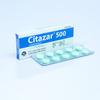
Citazar 250 mg
Generic: Levetiracetam
Category: Tablet
Manufacturer: ACI Limited

Price: 302.2 ৳
20's pack
10's Strip

Medicine Selling service is not available yet.
Alternative Brands & Related Medicines



Indications
Citazar is indicated as monotherapy in the treatment of partial-onset seizures with or without secondary generalisation in adults and adolescents from 16 years of age with newly diagnosed epilepsy. Citazar is indicated as adjunctive therapy-
in the treatment of partial-onset seizures with or without secondary generalization in adults, adolescents, children and infants from 1 month of age with epilepsy. ... Read moreCitazar is indicated as monotherapy in the treatment of partial-onset seizures with or without secondary generalisation in adults and adolescents from 16 years of age with newly diagnosed epilepsy. Citazar is indicated as adjunctive therapy-
in the treatment of partial-onset seizures with or without secondary generalization in adults, adolescents, children and infants from 1 month of age with epilepsy.
in the treatment of myoclonic seizures in adults and adolescents from 12 years of age with Juvenile Myoclonic Epilepsy.
in the treatment of primary generalized tonic-clonic seizures in adults and adolescents from 12 years of age with Idiopathic Generalised Epilepsy.
Therapeutic Class
Adjunct anti-epileptic drugs
Pharmacology
The exact mechanism of anticonvulsant effect is unknown but does not involve inhibitory and excitatory neurotransmission. Stereo-selective binding of Levetiracetam was confined to synaptic plasma membranes in the central nervous system with no binding occurring in peripheral tissue.Studies show that levetiracetam affects intraneuronal Ca levels by partial inhibition of N-type Ca currents and by reducing the release of Ca from intraneuronal stores; facilitates GABA-ergic inhibitory transmission through displacement of negative modulators; reduces delayed rectifier K current; and/or binds to synaptic proteins which modulate neurotransmitter release.
Interaction
Antiepileptic medicinal products: Pre-marketing data from clinical studies conducted in adults indicate that levetiracetam did not influence the serum concentrations of existing antiepileptic medicinal products (phenytoin, carbamazepine, valproic acid, phenobarbital, lamotrigine, gabapentin and primidone) and that these antiepileptic medicinal products did not influence the pharmacokinetics of levetiracetam.Probenecid: Probenecid (500 mg four times daily), a renal tubular secretion blocking agent, has been shown to inhibit the renal clearance of the primary metabolite but not of levetiracetam. Nevertheless, the concentration of this metabolite remains low.Methotrexate: Concomitant administration of levetiracetam and methotrexate has been reported to decrease methotrexate clearance, resulting in increased/prolonged blood methotrexate concentration to potentially toxic levels. Blood methotrexate and levetiracetam levels should be carefully monitored in patients treated concomitantly with the two drugs.Laxatives: There have been isolated reports of decreased levetiracetam efficacy when the osmotic laxative macrogol has been concomitantly administered with oral levetiracetam. Therefore, macrogol should not be taken orally for one hour before and for one hour after taking levetiracetam.Food and alcohol: The extent of absorption of levetiracetam was not altered by food, but the rate of absorption was slightly reduced. No data on the interaction of levetiracetam with alcohol are available.
Contraindications
Hypersensitivity to the active substance or other pyrrolidone derivatives or to any of the excipients.
Side Effects
Most common adverse reactions (incidence ≥ 5% more than placebo) include:
Adult patients: somnolence, asthenia, infection and dizziness
Pediatric patients: fatigue, aggression, nasal congestion, decreased appetite, and irritability
Pregnancy And Lactation
Pregnancy category C. No data on the use of Levetiracetam in breast feeding women are available. Data from animals indicate that Levetiracetam is secreted into milk.Therefore Levetiracetam is contraindicated during breast-feeding.
Precautions And Warnings
Renal impairment: The administration of levetiracetam to patients with renal impairment may require dose adjustment. In patients with severely impaired hepatic function, assessment of renal function is recommended before dose selection.Acute kidney injury: The use of levetiracetam has been very rarely associated with acute kidney injury with a time to onset ranging from a few days to several months.Blood cell counts: Rare cases of decreased blood cell counts (neutropenia, agranulocytosis, leucopenia, thrombocytopenia and pancytopenia) have been described in association with levetiracetam administration, generally at the beginning of the treatment. Complete blood cell counts are advised in patients experiencing important weakness, pyrexia, recurrent infections or coagulation disorders.Suicide: Suicide, suicide attempt, suicidal ideation and behaviour have been reported in patients treated with anti-epileptic agents (including levetiracetam). A meta-analysis of randomized placebo-controlled trials of anti-epileptic medicinal products has shown a small increased risk of suicidal thoughts and behaviour. The mechanism of this risk is not known. Therefore patients should be monitored for signs of depression and/or suicidal ideation and behaviours and appropriate treatment should be considered. Patients (and caregivers of patients) should be advised to seek medical advice should signs of depression and/or suicidal ideation or behaviour emerge.Paediatric population: The tablet formulation is not adapted for use in infants and children under the age of 6 years. Available data in children did not suggest an impact on growth and puberty. However, long term effects on learning, intelligence, growth, endocrine function, puberty and childbearing potential in children remain unknown.
Overdose Effects
Somnolence, agitation, aggression, depressed level of consciousness, respiratory depression and coma were observed with levetiracetam overdoses. After an acute overdose, the stomach may be emptied by gastric lavage or by induction of emesis. There is no specifc antidote for levetiracetam. Treatment of an overdose will be symptomatic and may include haemodialysis. The dialyser extraction efficiency is 60 % for levetiracetam and 74% for the primary metabolite.
Storage Conditions
Store at a cool temperature (not exceeding 25°C) and dry place, protected from light.
Drug Classes
Adjunct anti-epileptic drugs
Pregnancy Category
Levetiracetam is not recommended during pregnancy and in women of childbearing potential not using contraception unless clinically necessary. Levetiracetam is excreted in human breast milk. Therefore, breastfeeding is not recommended. However, if levetiracetam treatment is needed during breastfeeding, the benefit/risk of the treatment should be weighed considering the importance of breastfeeding. No impact on fertility was detected in animal studies. No clinical data are available, the potential risk for humans is unknown.

Samm Care