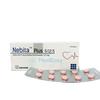
The Combination of these ingredients has an additive antihypertensive effect, reducing blood pressure to a greater degree than either component alone. This combination has mild vasodilating properties which reduces heart rate and blood pressure in hypertensive patients. Hydrochlorothiazide affects the renal tubular mechanisms of electrolyte reabsorption which directly increase the excretion of sodium and chloride in approximately equivalent amounts. The diuretic action of Hydrochlorothiazide reduces plasma volume, increases plasma renin activity and increases aldosterone secretion.
How to use Nebivolol + Hydrochlorothiazide:
Take this medicine in the dose and duration as advised by your doctor. Swallow it as a whole. Do not chew, crush or break it. Nebivolol + Hydrochlorothiazide may be taken with or without food, but it is better to take it at a fixed time.
Adult Dose:
Oral
Hypertension
Adult: Per tablet contains nebivolol 5 mg and hydrochlorothiazide 12.5 mg: 1 tablet once daily.
Symptomatic hyponatraemia when combined with carbamazepine. Predisposes to allopurinol sensitivity reactions and impaired renal function. Potentiates hypotensive effect of beta blockers and ACE inhibitors; these also reduce diuretic-induced hypokalaemia.
Potentially Fatal: Enhance neuromuscular blocking action of competitive muscle relaxants. Cross-allergy with sulphonamides and sulphonylurea hypoglycaemics with resultant acute interstitial nephritis and vasculitis. Potentiates bone-marrow suppression caused by anticancer drugs. Potentiates aminoglycoside nephrotoxicity. Impaired control of diabetes by oral hypoglycaemic agents. May precipitate digitalis toxicity and lithium toxicity. Increased risk of hypokalaemia with corticosteroids. Prolongs paralysis caused by tubocurarine.
This combination is not recommended during pregnancy. It is also not recommended for mothers who are breast-feeding
Precaution:
History of allergies, psoriasis, hyperthyroidism, peripheral arterial disease, diabetes, existing electrolyte disturbances, oedema, renal impairment, hyperlipidemia,hyperuricaemia. Elderly.
No data are available on Overdosage. Overdosage with Hydrochlorothiazide is associated with electrolyte depletion and dehydration resulting from excessive diuresis.
Protect from light & moisture. Store below 30° C. Keep out of reach of children.
Combined antihypertensive preparations
Nebivolol exerts its actions by exhibiting a high selectivity for beta-1 adrenergic receptors and also by reducing the peripheral vascular resistance by modulating nitrous oxide release.
Hydrochlorothiazide inhibits the reabsorption of Na and chloride at the beginning of distal convoluted tubule. It causes natriuretic effect mainly by decreasing Na and chloride reabsorption in the cortical segment of the ascending limb of the Loop of Henle by inhibition of a specific Na+Cl- co-transporter.
This combination is not recommended during pregnancy. It is also not recommended for mothers who are breast-feeding