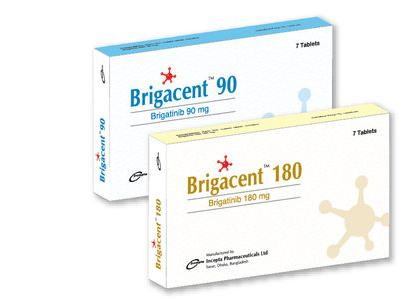
Brigacent 90 90 mg
Brigatinib
Category: Tablet
Manufacturer: Incepta Pharmaceuticals Ltd.

Allopathic
MFG. Licence No. Biological
193
MFG. Licence No. Non-Biological
108
Address
Zirabo, Savar, Dhaka Dewan Idris Road, Bara Rangamatia
Price: 6650.0 ৳
Box

Medicine Selling service is not available yet.
Related Medicines

Non-Small Cell Lung Cancer
Cytotoxic Chemotherapy
Brigatinib is a tyrosine kinase inhibitor with in vitro activity at clinically achievable concentrations against multiple kinases including ALK, ROS1, insulin-like growth factor-1 receptor (IGF-1R), and FLT-3 as well as EGFR deletion and point mutations. Brigatinib inhibited autophosphorylation of ALK and ALK-mediated phosphorylation of the downstream signalin proteins STAT3, AKT, ERK1/2, and S6 in in vitro and in vivo assays. Brigatinib also inhibited the in vitro proliferation of cell lines expressing EML4-ALK and NPM-ALK fusion proteins and demonstrated dose-dependent inhibition ofEML4-ALK-positive NSCLC xenograft growth in mice.At clinically achievable concentrations (≤500 nM), brigatinib inhibited the in vitro viability of cells expressing EML4-ALK and 17 mutant forms associated with resistance to ALK inhibitors including crizotinib, as well as EGFR-Del (E746-A750), ROS1 L2026M, FLT3-F691L, and FLT3-D835Y. Brigatinib exhibited in vivo antitumor activity against 4 mutant forms of EML4-ALK, including G1202R and L1196M mutants identified in NSCLC tumors in patients who have progressed on crizotinib. Brigatinib also reduced tumor burden and prolonged survival in mice implanted intracranially with an ALK-driven tumor cell line.
Administration:
Take with or without food
Adult Dose:
Non-Small Cell Lung Cancer
Indicated for anaplastic lymphoma kinase (ALK)-positive metastatic non-small cell lung cancer (NSCLC) in patients who have progressed on or are intolerant to crizotinib
90 mg PO qDay for the first 7 days; if 90 mg/day is tolerated, increase the dose to 180 mg PO qDay
Continue until disease progression or unacceptable toxicity
Hepatic impairment
Mild or moderate (Child-Pugh A or B): No dose adjustment required
Severe (Child-Pugh C): Reduce once daily dose by ~40% (eg, from 180 mg to 120 mg, 120 mg to 90 mg, or from 90 mg to 60 mg)
Renal Dose:
Renal impairment
Mild or moderate (CrCl 30-89 mL/min): No dose adjustment required
Severe (CrCl 15-29 mL/min): Reduce brigatinib dose by ~50% (eg, from 180 mg to 90 mg, or from 90 mg to 60 mg)
Increased plasma conc & adverse reactions w/ strong CYP3A inhibitors [eg, certain antivirals (boceprevir, cobicistat, indinavir, lopinavir, nelfinavir, ritonavir, saquinavir), macrolide antibiotics (clarithromycin), antifungals (itraconazole, ketoconazole, posaconazole, voriconazole), conivaptan]; grapefruit or grapefruit juice. Decreased plasma conc & efficacy w/ strong CYP3A inducers (eg, rifampin, carbamazepine, phenytoin, St. John's Wort). Decreased conc & loss of efficacy of CYP3A substrates (eg, hormonal contraceptives).
It is contraindicated in patients with known hypersensitivity to Brigatinib or any other components of this product.
>10%
Increased AST (38%)
Hyperglycemia (38%)
Increased ALT (34%)
Nausea (33%)
Fatigue (29%)
Headache (28%)
Increased CPK (27%)
Increased amylase (27%)
Dyspnea (27%)
Vomiting (24%)
Anemia (23%)
Decreased appetite (22%)
Prolonged aPTT (22%)
Increased lipase (21%)
Diarrhea (19%)
Constipation (19%)
Lymphopenia (19%)
Cough (18%)
Abdominal pain (17%)
Increased alkaline phosphatase (15%)
Decreased phosphorous (15%)
Rash (15%)
Pyrexia (14%)
Arthralgia (14%)
Peripheral neuropathy (13%)
Muscle spasms (12%)
Hypertension (11%)
Pain in extremity (11%)
Insomnia (11%)
1-10%
Back pain (10%)
Myalgia (9.2%)
Visual disturbances (7.3%)
Pneumonia (4.6%)
Interstitial lung disease/pneumonitis (3.7%)
<1%
Hypoxia (0.9%)
Based on its mechanism of action and findings in animals, Brigatinib can cause fetal harm when administered to a pregnant woman. There are no clinical data on the use of Brigatinib in pregnant women. There are no data regarding the secretion of Brigatinib in human milk or its effects on the breastfed infant or milk production. Because of the potential for adverse reactions in breastfed infants, advise lactating women not to breastfeed during treatment with Brigatinib and for 1 week following the final dose.
Precaution:
Risk of interstitial lung disease (ILD)/pneumonitis; HTN; bradycardia; visual disturbances (eg, blurred vision, diplopia, & reduced visual acuity); creatine phosphokinase (CPK) & pancreatic enzyme elevation; hyperglycemia. Withhold treatment in patients w/ Grade 3 or 4 CPK elevation; Grade 3 or 4 pancreatic enzyme elevation; inadequate hyperglycemic control. Discontinue in case of Grade 3 or 4 ILD/pneumonitis or recurrence of Grade 1 or 2 ILD/pneumonitis; Grade 4 HTN or recurrence of Grade 3 HTN; life-threatening bradycardia; Grade 4 visual disturbances.
Use w/ caution in combination w/ antihypertensive agents causing bradycardia. Females of reproductive potential should use effective non-hormonal contraception during treatment & for at least 4 mth following the final dose. Males w/ female partners of reproductive potential should use effective contraception during treatment & for at least 3 mth after last dose. Pregnancy & lactation. Childn.
Keep below 30°C temperature, away from light & moisture. Keep out of the reach of children.
Cytotoxic Chemotherapy
Tyrosine kinase inhibitor with in vitro activity at clinically achievable concentrations against multiple kinases, including ALK, ROS1, insulinlike growth factor-1 receptor (IGF-1R), and FLT-3, as well as EGFR deletion and point mutations
Brigatinib inhibited autophosphorylation of ALK and ALK-mediated phosphorylation of the downstream signaling proteins STAT3, AKT, ERK1/2, and S6 in in vitro and in vivo assays
Exhibited in vivo antitumor activity against 4 mutant forms of EML4-ALK, including G1202R and L1196M mutants identified in NSCLC tumors in patients who have progressed on crizotinib
Also reduced tumor burden and prolonged survival in mice implanted intracranially with an ALK-driven tumor cell line
Pregnancy
Based on its mechanism of action and findings in animals, can cause fetal harm when administered to pregnant women
Administration to pregnant rats during the period of organogenesis resulted in dose-related skeletal anomalies at doses as low as 12.5 mg/kg/day (~0.7 times the human exposure by AUC at 180 mg once daily), as well as increased postimplantation loss, malformations, and decreased fetal body weight at doses of 25 mg/kg/day (~1.26 times the human exposure at 180 mg once daily) or greater
Infertility: Based on findings in male reproductive organs in animals, may cause reduced fertility in males
Contraception
Females: Advise females of reproductive potential to use effective nonhormonal contraception during treatment and for at least 4 months after the final dose
Counsel patients to use a nonhormonal method of contraception since brigatinib can render some hormonal contraceptives ineffective
Males: Because of the potential for genotoxicity, advise males with female partners of reproductive potential to use effective contraception during treatment and for at least 3 months after the final dose
Lactation
Unknown if distributed in human breast milk
Because of the potential for adverse reactions in breastfed infants, advise lactating women not to breastfeed during treatment and for 1 week following the final dose


Samm Care