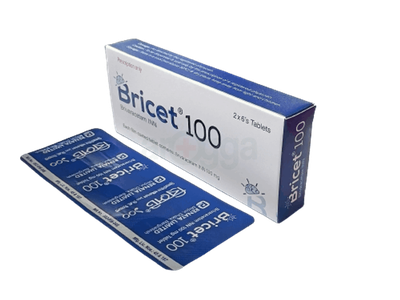
Bricet-100 100 mg
Brivaracetam
Category: Tablet
Manufacturer: Renata Limited

Allopathic
MFG. Licence No. Biological
045
MFG. Licence No. Non-Biological
197
Address
Plot No. 1, Sec-7, Milk Vita Road, Mirpur, Dhaka.
Price: 126.0 ৳
Tablet

Medicine Selling service is not available yet.
Related Medicines
Uses of Bricet-100:
- Epilepsy/Seizures
Partial-Onset Seizures, Adjunctive therapy in treating partial-onset seizures w/ or w/o secondary generalisation in adults & adolescents ≥16 yr w/ epilepsy.
Hypersensitivity; bronchospasms and angioedema have occurred
Adjunct anti-epileptic drugs
The precise mechanism by which Brivaracetam exerts its anticonvulsant activity is not known. Brivaracetam displays a high and selective affinity for synaptic vesicle protein 2A (SV2A) in the brain, which may contribute to the anticonvulsant effect.Brivaracetam binds SV2A with high affinity. SV2A is known to play a role in epileptogenesis through modulation of synaptic GABA release. It is thought that brivaracetam exerts its anti-epileptogenic effects through its binding to SV2A. Brivaracetam is also known to inhibit Na+ channels which may also contribute to its anti-epileptogenic action
How to use
Brivaracetam:
Take this medicine in the dose and duration as advised by your doctor. Swallow it as a whole. Do not chew, crush or break it.
Brivaracetam may be taken with or without food, but it is better to take it at a fixed time.
Adult Dose:
Partial-Onset Seizures
Indicated for partial-onset seizures
50 mg PO/IV q12hr initially; based on individual patient tolerability and therapeutic response, adjust dose between to 25-100 mg PO/IV BID (50-200 mg/day)
Injection may be used for patients when oral administration is temporarily not feasible; clinical study experience with injection is limited to 4 consecutive days of treatment
Hepatic impairment
All stages: Decrease starting dose to 25 mg BID and do not exceed 75 mg BID (150 mg/day)
Child Dose:
Partial Onset Seizures
Tablets or oral solution
Indicated for partial-onset seizures in children and adolescents ?4 years
<4 years: Safety and efficacy not established
4 to <16 years
11 to <20 kg: 0.5-1.25 mg/kg PO BID (1-2.5 mg/kg/day) initially; based on individual patient tolerability and therapeutic response, adjust dose between to 0.5-2.5 mg/kg PO BID (1-5 mg/kg/day)
20 to <50 kg: 0.5-1 mg/kg PO BID (1-2 mg/kg/day) initially; based on individual patient tolerability and therapeutic response, adjust dose between to 0.5-2 mg/kg PO BID (1-4 mg/kg/day)
?50 kg: 25-50 mg PO BID (50-100 mg/day) initially; based on individual patient tolerability and therapeutic response, adjust dose between to 25-100 mg PO BID (50-200 mg/day)
>16 years
50 mg PO BID (100 mg/day) initially; based on individual patient tolerability and therapeutic response, adjust dose between to 25-100 mg PO BID (50-200 mg/day)
Injection
Indicated for partial-onset seizures in adolescents ?16 years with epilepsy
Injection may be used for patients when oral administration is temporarily not feasible
<16 years: Safety and efficacy not established
>16 years: 50 mg IV q12hr initially; based on individual patient tolerability and therapeutic response, adjust dose between to 25-100 mg IV BID (50-200 mg/day)
Clinical study experience with injection is limited to 4 consecutive days of treatment
Renal Dose:
Renal impairment
Mild-to-moderate: No dose adjustment required
ESRD undergoing dialysis: Not studied
Doubled effect of alcohol on psychomotor function, attention & memory. Possible increase in plasma conc w/ strong CYP2C19 inhibitors (eg, fluconazole, fluvoxamine). Decreased plasma conc w/ strong enzyme inducers (eg, rifampicin; carbamazepine, phenobarb, phenytoin; St. John's wort). May increase plasma conc of CYP2C19-metabolised products (eg, lansoprazole, omeprazole, diazepam); OAT3-transported medicinal products. May decrease plasma conc of CYP2B6-metabolised products (eg, efavirenz). Increased conc of carbamazepine epoxide.
Hypersensitivity; bronchospasms and angioedema have occurred
Common
- Dizziness
- Fatigue
- Nausea
- Sleepiness
- Vomiting
- Constipation
- Irritation
>10%
Somnolence and sedation (16%)
Dizziness (12%)
1-10%
Fatigue (9%)
Nausea and vomiting (5%)
Cerebellar coordination and balance disturbances (3%)
Irritability (3%)
Constipation (2%)
There is a pregnancy exposure registry that monitors pregnancy outcomes in women exposed to antiepileptic drugs (AEDs), such as Brivaracetam, during pregnancy. No data are available regarding the presence of brivaracetam in human milk, the effects on the breastfed infant, or the effects of the drug on milk production. Studies in lactating rats have shown excretion of brivaracetam or metabolites in milk
Precaution:
Monitor patients for signs of suicidal ideation & behaviours. Minor or moderate influence on the ability to drive & use machines. Hepatic impairment. Not recommended in end-stage renal disease patients undergoing dialysis. Women of childbearing potential. Pregnancy & lactation. Elderly ≥65 yr. Childn <16 yr. FC tab: Rare hereditary problems of galactose intolerance, Lapp lactase deficiency or glucose-galactose malabsorption. Oral soln: Rare hereditary problems of fructose intolerance. Contains methyl parahydroxybenzoate (E218). Oral soln & vial: Patients on controlled Na diet.
Store at 25°C; excursions permitted between 15°C to 30°C
Adjunct anti-epileptic drugs
Exact mechanism unknown
Displays a high and selective affinity for synaptic vesicle protein 2A (SV2A) in the brain, which may contribute to the anticonvulsant effect
Pregnancy
No adequate and well-controlled studies in pregnant women
In animal studies, brivaracetam produced evidence of developmental toxicity at plasma exposures greater than clinical exposure
Lactation
Unknown if distributed in human breast milk
Studies in rats have shown excretion in milk
Because many drugs are excreted into human milk, a decision should be made whether to discontinue nursing or to discontinue the drug, taking into account the importance of the drug to the mother


Samm Care