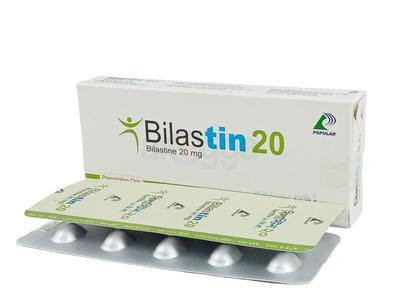
Bilastin 20 20 mg
Bilastine
Category: Tablet
Manufacturer: Popular Pharmaceuticals Ltd.

Price: 135.0 ৳
Strip

Medicine Selling service is not available yet.
Related Medicines


Uses of Bilastin 20:
- Allergic conditions
Nasal congestion, urticaria
Hypersensitivity
Non-sedating antihistamines
Bilastine is a non-sedative H1 receptor selective antagonist. Its principal effects are mediated via selective inhibition of peripheral H1-receptors. It shows moderate to high affinity for histamine H1-receptors and no affinity for muscarinic, serotonergic, dopaminergic and noradrenergic receptors.
How to use Bilastine:
Take this medicine in the dose and duration as advised by your doctor. Swallow it as a whole. Do not chew, crush or break it. Bilastine is to be taken empty stomach.
Administration:
Take the tablet on empty stomach is (one hour before a meal, or alternatively, two hours after eating a meal).
Adult Dose:
The usual dose for adults is one tablet (20 mg) daily.
Child Dose:
The usual dose for children aged over 12 years, is one tablet (20 mg) daily.
Concomitant intake of Bilastine and Ketoconazole or Erythromycin or Diltiazem increased C max of Bilastine. The psychomotor performance after concomitant intake of alcohol and Bilastine was similar to that observed after intake of alcohol and placebo. Concomitant intake of Bilastine and Lorazepam 3 mg for 8 days did not potentiate the depressant CNS effects of Lorazepam.
Hypersensitivity
Common
- Headache
- Drowsiness
Feeling sleepy
Headache
There are no adequate or limited amount of data for the use of Bilastine in pregnant women and during breast feeding and on the effects on fertility. In case of pregnancy or breast feeding, Bilastine should be avoided during pregnancy, unless advised otherwise by a physician.
Precaution:
Use caution when drive, or before using tools or machines.
In clinical trials, after administration of Bilastine at doses 10 to 11 times the therapeutic dose (220 mg as single dose; or 200 mg/day for 7 days) frequency of treatment-emergent adverse events was two times higher than with placebo. The adverse reactions most frequently reported were dizziness, headache and nausea. No serious adverse events and no significant prolongation in the QTc interval were reported.
Keep below 30°C temperature, protected from light and moisture. Keep out of reach of children.
Non-sedating antihistamines
Bilastine is a selective histamine H1 receptor antagonist Label. During allergic response mast cells undergo degranulation which releases histamine and other subastances. By binding to and preventing activation of the H1 receptor, bilastine reduces the development of allergic symptoms due to the release of histamine from mast cells.
There are no or limited amount of data from the use of Bilastine in pregnant women. Animal studies do not indicate direct or indirect harmful effects with respect to reproductive toxicity, parturition or postnatal development. As a precautionary measure, it is preferable to avoid the use of Bilastine during pregnancy. The excretion of Bilastine in milk has not been studied in humans. A decision must be made taking into account the benefit of breast-feeding for the child and the benefit of Bilastine therapy for the mother.


Samm Care