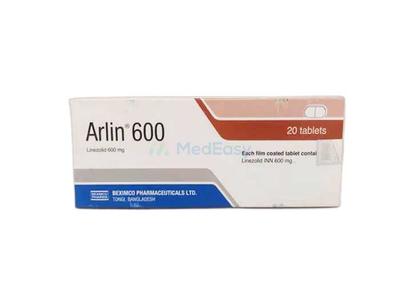
Arlin 600 mg
Linezolid
Category: Tablet
Manufacturer: Beximco Pharmaceuticals Ltd.

Allopathic
MFG. Licence No. Biological
119
MFG. Licence No. Non-Biological
379
Address
Tongi I/A, Gazipur
Price: 85.0 ৳
2 x 10 in Blister Pack
20's pack
10's Strip
piece

Medicine Selling service is not available yet.
Related Medicines


Uses of Arlin:
- Severe bacterial infections
Community-acquired pneumonia, Skin and skin structure infections, Nosocomial pneumonia
Linzolid formulations are contraindicated for use in patients who have known hypersensitivity to Linzolid or any of the other product components. Linzolid should not be used in patients taking any medicinal product which inhibits monoamine oxidases A or B (e.g. phenelzine, isocarboxazid) or within two weeks of taking any such medicinal product. Linzolid should not be administered to patients with uncontrolled hypertension, pheochromocytoma, thyrotoxicosis, carcinoid syndrome and/or patients taking directly and indirectly acting sympathomimetic agents (e.g. pseudoephedrine), vasopressive agents (e.g. epinephrine, norepinephrine), dopaminergic agents (e.g. dopamine, dobutamine), serotonin re-uptake inhibitors, tricyclic antidepressants, serotonin 5-HT1 receptor agonists (triptans), meperidine or buspirone.
Macrolides
Linezolid is a synthetic, antibacterial agent belonging to a new class of antibiotics, the oxazolidinones, with in vitro activity against Gram positive aerobic bacteria, some Gram positive anaerobic bacteria and certain Gram negative bacteria. It selectively inhibits bacterial protein synthesis via a mechanism of action different from that of other antibacterial agents. Linezolid binds to the 23S ribosomal RNA of the 50S subunit of the bacterial ribosome and prevents the formation of a functional 70S initiation complex which is an essential component of the bacterial translation process. The results of time-kill studies have shown Linezolid to be bacteriostatic against enterococci and staphylococci. For streptococci, Linezolid was found to be bactericidal for the majority of strains.
How to use
Linezolid:
Take this medicine in the dose and duration as advised by your doctor. Swallow it as a whole. Do not chew, crush or break it.
Linezolid may be taken with or without food, but it is better to take it at a fixed time.
Avoid
Linezolid with tyramine-rich food such as cheese, smoked fish, meats and some types of beer.
Administration:
May be taken with or without food.
Adult Dose:
Oral
Uncomplicated skin and skin structure infections
Adult: 400 mg 12 hrly for 10-14 days.
Vancomycin-resistant Enterococcus faecium
Adult: 600 mg 12 hrly for 14-28 days.
Methicillin-resistant Staphylococcus aureus infections
Adult: 600 mg bid for 7-21 days.
Community-acquired pneumonia; Nosocomial pneumonia; Complicated skin and skin structure infections
Adult: 600 mg 12 hrly for 10-14 days.
Elderly: No dosage adjustment needed.
Hepatic impairment: Mild to moderate: No dosage adjustment needed.
Child Dose:
Oral
For Pediatric Patients
Pneumonia, complicated skin infections, vancomycin resistant enterococci:
Birth–11 y: 30 mg/kg/day q8h
>11 y: 1,200 mg/day q12h
Uncomplicated skin infections:
Birth–5 y: 30 mg/kg/day q8h
5–11 y: 20 mg/kg/day q12h
>11–18 y: 1,200 mg/day q12h
Renal Dose:
Renal impairment: No dosage adjustment needed.
May reduce serum levels w/ rifampicin and phenytoin. May cause hypoglycaemia w/ insulin or oral antidiabetics. May increase risk of seizures w/ tramadol.
Potentially Fatal: Increased risk of serotonin syndrome w/ MAOIs, TCAs, SNRIs, or other serotonergic drugs (e.g. bupropion, vilazodone, mirtazapine, amoxapine, buspirone, maprotiline, meperidine, trazodone, nefazodone). Significant increase in BP w/ vasopressive agents (e.g. epinephrine, norepinephrine), sympathomimetic agents (e.g. pseudoephedrine) and dopaminergic agents (e.g. dopamine, dobutamine).
Linzolid formulations are contraindicated for use in patients who have known hypersensitivity to Linzolid or any of the other product components. Linzolid should not be used in patients taking any medicinal product which inhibits monoamine oxidases A or B (e.g. phenelzine, isocarboxazid) or within two weeks of taking any such medicinal product. Linzolid should not be administered to patients with uncontrolled hypertension, pheochromocytoma, thyrotoxicosis, carcinoid syndrome and/or patients taking directly and indirectly acting sympathomimetic agents (e.g. pseudoephedrine), vasopressive agents (e.g. epinephrine, norepinephrine), dopaminergic agents (e.g. dopamine, dobutamine), serotonin re-uptake inhibitors, tricyclic antidepressants, serotonin 5-HT1 receptor agonists (triptans), meperidine or buspirone.
Common
- Vomiting
- Headache
- Nausea
- Decreased blood cells (red cells, white cells, and platelets)
- Diarrhea
>10%
Pediatrics
Diarrhea (7.8-10.8%)
1-10%
Headache (5.7-8.8%).Diarrhea (8.2-8.3%),Nausea (5.1-6.6%),Vomiting (2-4.3%),Dizziness (1.8-2.6%),Rash (1.1-2.3%),Vaginal moniliasis (1.1-1.8%),Taste alteration (1-1.8%),Oral moniliasis (0.5-1.7%),Abnormal LFTs (0.4-1.6%),Fungal infection (0.3-1.5%),Localized abdominal pain (1.2-1.3%),Tongue discoloration (0.3-1.3%),Generalized abdominal pain (0.9-1.2%)
Pediatrics
Vomiting (2.9-9.4%),Headache (0.9-6.5%),Anemia (5.6%),Thrombocytopenia (4.7%),Nausea (1.9-3.7%),Generalized abdominal pain (0.9-2.4%),Localized abdominal pain (0.5-2.4%),Loose stools (1.6-2.3%),Eosinophilia (0.4-1.9%),Pruritus, other than application site (0.8-1.4%),Vertigo (1.2%)
<1%
Lactic acidosis,Myelosuppression,Peripheral neuropathy,Disorder of optic nerve,Serotonin syndrome
Potentially Fatal: Reversible myelosuppression including anaemia, leukopenia, pancytopenia and thrombocytopenia (particularly if using > 10-14 days), transient ischaemic attacks, renal failure, Stevens-Johnson syndrome.
Pregnancy Category C. There are no adequate and well-controlled studies in pregnant women. Linezolid should be used during pregnancy only if the potential benefit justifies the potential risk to the fetus. It is not known whether Linezolid is excreted in human milk. Because many drugs are excreted in human milk, caution should be exercised when Linezolid is administered to a nursing woman.
Precaution:
Preexisting myelosuppression, renal impairment (CrCl < 30ml/min), uncontrolled hypertension, phaeochromocytoma, carcinoid syndrome, untreated hyperthyroidism, chronic infection, history of seizures, bipolar depression, schizophrenia or acute confusional states. Pregnancy and lactation. Monitor complete blood counts weekly. Give after haemodialysis. Not known if linezolid or metabolites removed during peritoneal dialysis.
Lactation: Unknown; use caution
No cases of overdose have been reported. Symptomatic and supportive care is advised together with maintenance of glomerular filtration. Approximately 30% of a Linezolid dose is removed during 3 hours of haemodialysis. No data are available for the removal of Linezolid by peritoneal dialysis or haemoperfusion.
Linezolid formulations should be stored at room temperature (15°C-30°C), away from light and moisture. All medicines should be kept away from children.
Macrolides
Linezolid is a bacteriostatic oxazolidinone which acts by inhibiting ribosomal protein synthesis. It is active against gm+ve bacteria including vancomycin-resistant enterococci and MRSA. It has limited in vitro activity against gm-ve bacteria.
Pregnancy Category C. There are no adequate and well-controlled studies in pregnant women. Linezolid should be used during pregnancy only if the potential benefit justifies the potential risk to the fetus. It is not known whether Linezolid is excreted in human milk. Because many drugs are excreted in human milk. Caution should be exercised when Linezolid is administered to a nursing woman.


Samm Care