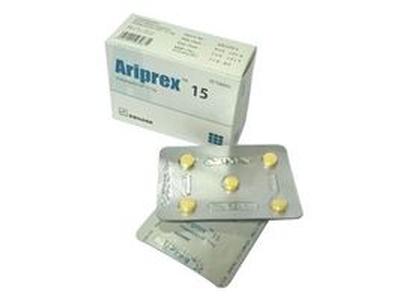
Ariprex 15 15mg
Generic: Aripiprazole
Category: Tablet
Manufacturer: Square Pharmaceuticals Ltd.

Price: 7.0 ৳
20 in Blister Pack
Box
Strip
Tablet

Medicine Selling service is not available yet.
Alternative Brands & Related Medicines

Indications
Uses of Ariprex 15:
- Schizophrenia
- Mania
Adult: PO Schizophrenia Initial: 10-15 mg once daily. Maintenance: 15 mg once daily. Max: 30 mg once daily without regard to food. Dose increment should not be made before 2 weeks, the time needed to achieve steady state.
Bipolar mania 30 mg once daily. May reduce to 15 mg once daily according to tolerability.
Major Depressive Disorder 2-5 mg/day PO initially; increased weekly PRN by <5 mg/day to dose range of 2-15 mg/day
Elderly: Reduce initial dose.
Schizophrenia
13-17 years: 2 mg/day PO initially; increased to 5 mg/day after 2 days; increased to recommended dosage of 10 mg/day after additional 2 days; may subsequently be increased by 5 mg/day; maintenance: 10-30 mg/day
Bipolar Mania
Acute manic or mixed episodes, either as monotherapy or as adjunct to lithium or valproate
10-17 years: 2 mg/day PO initially; increased to 5 mg/day after 2 days; increased to recommended dosage of 10 mg/day after additional 2 days; may subsequently be increased by 5 mg/day; maintenance: 10-30 mg/day
Autism
Irritability associated with autistic disorder
<6>1 week to target dosage of 5 mg/day; may gradually be further increased PRN to 10 mg/day or higher; not to exceed 15 mg/day
Tourette Disorder
6-18 years (<50 kg)
Initiate at 2 mg/day PO with a target dose of 5 mg/day after 2 days
The dose can be increased to 10 mg/day in patients who do not achieve optimal control of tics
Dosage adjustments should occur gradually at intervals of no less than 1 week
6-18 years (?50 kg)
Initiate at 2 mg/day PO for 2 days, and then increase to 5 mg/day for 5 days, with a target dose of 10 mg/day on day 8
The dose can be increased up to 20 mg/day for patients who do not achieve optimal control of tics
Dosage adjustments should occur gradually in increments of 5 mg/day at intervals of no less than 1 week
Therapeutic Class
Atypical neuroleptic drugs
Pharmacology
Aripiprazole is an atypical antipsychotic that has both dopamine and serotonin receptors activity. It is a partial agonist of dopamine D2 receptors that relieves the symptoms of schizophrenia. It is characterized as a dopamine system stabilizer. It is a potent partial agonist at serotonin 5-HT1A receptors and antagonist at 5-HT2A receptors. This is associated with improvement of depressive, cognitive and negative symptoms.
Dosage and Administration
How to use
Aripiprazole:
Take this medicine in the dose and duration as advised by your doctor. Swallow it as a whole. Do not chew, crush or break it.
Aripiprazole may be taken with or without food, but it is better to take it at a fixed time.
Administration:
Drugs that induce CYP3A4 (e.g. carbamazepine) could cause an increase in aripiprazole clearance and lower blood levels. Inhibitors of CYP3A4 (e.g. ketoconazole) or CYP2D6 (e.g. quinidine, fluoxetine or paroxetine) can inhibit aripiprazole elimination and cause increased blood levels. Increased CNS depression with ethanol.
Adult Dose:
Patients with known CV diseases (e.g. history of MI, IHD, CCF or conduction abnormalities), cerebrovascular diseases or conditions which would predispose patients to hypotension; Alzheimer's disease and dementia. Caution when operating hazardous machinery, including automobiles when taking aripiprazole. Pregnancy.
Lactation: Excreted in human breast milk; a decision should be made whether to discontinue nursing or to discontinue the drug, taking into account the importance of the drug to the mother
Renal Dose:
Aripiprazole acts as a partial agonist at D2 and 5-HT1A receptors and as an antagonist at 5-HT2A receptors.
Interaction
Hypersensitivity. Lactation. Children <18 yr.
Contraindications
Schizophrenia
13-17 years: 2 mg/day PO initially; increased to 5 mg/day after 2 days; increased to recommended dosage of 10 mg/day after additional 2 days; may subsequently be increased by 5 mg/day; maintenance: 10-30 mg/day
Bipolar Mania
Acute manic or mixed episodes, either as monotherapy or as adjunct to lithium or valproate
10-17 years: 2 mg/day PO initially; increased to 5 mg/day after 2 days; increased to recommended dosage of 10 mg/day after additional 2 days; may subsequently be increased by 5 mg/day; maintenance: 10-30 mg/day
Autism
Irritability associated with autistic disorder
<6>1 week to target dosage of 5 mg/day; may gradually be further increased PRN to 10 mg/day or higher; not to exceed 15 mg/day
Tourette Disorder
6-18 years (<50 kg)
Initiate at 2 mg/day PO with a target dose of 5 mg/day after 2 days
The dose can be increased to 10 mg/day in patients who do not achieve optimal control of tics
Dosage adjustments should occur gradually at intervals of no less than 1 week
6-18 years (?50 kg)
Initiate at 2 mg/day PO for 2 days, and then increase to 5 mg/day for 5 days, with a target dose of 10 mg/day on day 8
The dose can be increased up to 20 mg/day for patients who do not achieve optimal control of tics
Dosage adjustments should occur gradually in increments of 5 mg/day at intervals of no less than 1 week
Side Effects
Common
- Akathisia (inability to stay still)
- Anxiety
- Blurred vision
- Constipation
- Dizziness
- Fatigue
- Headache
- Increased saliva production
- Indigestion
- Insomnia (difficulty in sleeping)
- Nausea
- Parkinsonism
- Restlessness
- Sleepiness
- Tremor
- Vomiting
Pregnancy And Lactation
Aripiprazole should not be used in pregnancy as no human trial is performed. Patients should be advised not to breast feed an infant if they are taking aripiprazole.
Precautions And Warnings
Precaution:
Major depressive disorder, Schizophrenia, Acute manic episodes of bipolar disorder, Agitation, Irritability in autism
Overdose Effects
Aripiprazole at doses up to 1080 mg causes no fatalities. The signs and symptoms observed with aripiprazole overdose included nausea, vomiting, asthenia, diarrhea, and somnolence.
Drug Classes
Atypical neuroleptic drugs
Mode of Action
May be taken with or without food.
Pregnancy Category
>10%
Weight gain (8-30%),Headache (27%),Agitation (19%),Insomnia (18%),Anxiety (17%),Nausea and vomiting (11-15%),Akathisia (10-13%),Lightheadedness (11%),Constipation (10-11%)
1-10%
Dizziness (10%),Dyspepsia (9%),Somnolence (5-8%),Fatigue (6%),Restlessness (6%),Tremor (6%),Dry mouth/xerostomia (5%) ,Extrapyramidal disorder (5%),Orthostatic hypotension (1-5%),Musculoskeletal stiffness (4%),Abdominal discomfort (3%),Blurred vision (3%),Cough (3%),Pain (3%),Myalgia (2%),Rash,Rhinitis
<1%
Altered mental status,Autonomic instability,Dysphagia,Hyperpyrexia,Muscle rigidity,Neuroleptic malignant syndrome (NMS),Seizure,Tardive dyskinesia


Samm Care