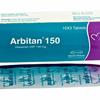
Arbitan 300 mg
Irbesartan
Category: Tablet
Manufacturer: Opsonin Pharma Limited

Allopathic
MFG. Licence No. Biological
012
MFG. Licence No. Non-Biological
080
Address
Rupatali,
Price: 21.68 ৳
Tablet

Medicine Selling service is not available yet.
Related Medicines
Uses of Arbitan:
- Hypertension (high blood pressure)
Diabetic nephropathy, Hypertension
Hypersensitivity; pregnancy and lactation.
Angiotensin-ll receptor blocker
Irbesartan is an angiotensin II receptor antagonist. It blocks the vasoconstricting and aldosterone-secreting effects of angiotensin II by binding to AT1 receptors.
How to use
Irbesartan:
Take this medicine in the dose and duration as advised by your doctor. Swallow it as a whole. Do not chew, crush or break it.
Irbesartan may be taken with or without food, but it is better to take it at a fixed time.
Administration:
May be taken with or without food.
Adult Dose:
Oral
Hypertension
Adult: 150 mg once daily, may increase to 300 mg once daily if needed. Patient w/ intravascular volume depletion: Initially, 75 mg once daily.
Elderly: >75 yr Initially, 75 mg once daily.
Diabetic nephropathy in Type 2 diabetes mellitus
Adult: Initially, 75-150 mg once daily, may increase to 300 mg once daily if needed.
Child Dose:
Hypertension
<6 years: Safety and efficacy not established
6-12 years: 75 mg/day PO initially; not to exceed 150 mg/day
>12 years: 150 mg/day PO initially; may be increased to 300 mg/day PO
Renal Dose:
Renal impairment:
Haemodialysis: Initially, 75 mg once daily.
Mild-to-severe renal impairment: Dosage adjustment not necessary unless patient is hypovolemic
May antagonise hypotensive effect and increase risk of nephrotoxicity w/ NSAIDs. May increase serum lithium levels and toxicity. Increased risk of hyperkalaemia w/ K-sparing diuretics (e.g. amiloride, triamterene, spironolactone), K supplements or K-containing salt substitutes.
Potentially Fatal: May increase nephrotoxic, hyperkalaemic and hypotensive effect w/ aliskiren in patients w/ diabetes and renal impairment (GFR <60 mL/min).
Hypersensitivity; pregnancy and lactation.
Common
- Dizziness
- Increased potassium level in blood
>10%
Hyperkalemia (19%)
1-10%
Dizziness (10%),Upper respiratory tract infection (URTI) (9%),Orthostatic hypotension (5%),Fatigue (4%),Diarrhea (3%),Dyspepsia (2%)
Pregnancy: Irbesartan is contraindicated in the second and third trimesters of pregnancy. In the second and third trimesters, substances that act directly on the renin-angiotensin-system can cause foetal or neonatal renal failure, foetal skull hypoplasia and even foetal death. As precautionary measure, irbesartan should preferably not be used during first trimester of pregnancy. A switch to a suitable alternative treatment should be carried out in advance of a planned pregnancy. If pregnancy is diagnosed, irbesartan should be discontinued as soon as possible, skull and renal function should be checked with echography if, inadvertently, the treatment was taken for a long period.Lactation: Irbesartan is contraindicated during lactation. It is not known whether irbesartan is excreted in human milk. Irbesartan is excreted in the milk of lactating rats. Precautions: Intravascular volume depletion: symptomatic hypotension, especially after the first dose, may occur in patients who are volume and/or sodium depleted by vigorous diuretic therapy, dietary salt restriction, diarrhoea or vomiting. Such conditions should be corrected before the administration of Irbesartan.
Precaution:
Child <6 yr. Unilateral or bilateral renal artery stenosis; vol or Na depletion; aortic or mitral valve stenosis, hypertrophic cardiomyopathy.
Lactation: Potential harm to nursing infant; discontinue drug, or do not nurse
Experience in adults exposed to doses of up to 900 mg/day for 8 weeks revealed no toxicity. The most likely manifestations of overdosage are expected to be hypotension and tachycardia; bradycardia might also occur from overdose. No specific information is available on the treatment of overdosage with Irbesartan. The patient should be closely monitored, and the treatment should be symptomatic and supportive. Suggested measures include induction of emesis and/or gastric lavage. Activated charcoal may be useful in the treatment of overdosage. Irbesartan is not removed by haemodialysis.
Store in a cool and dry place, protected from light.
Angiotensin-ll receptor blocker
Irbesartan is an angiotensin II receptor antagonist. It blocks the vasoconstricting and aldosterone-secreting effects of angiotensin II by binding to AT1 receptors.
Pregnancy category: 1st trimester, C; 2nd and 3rd trimesters, D

Samm Care