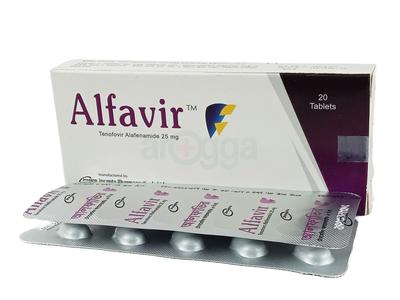
Alfavir 25 mg
Generic: Tenofovir Alafenamide
Category: Tablet
Manufacturer: Incepta Pharmaceuticals Ltd.

Allopathic
MFG. Licence No. Biological
193
MFG. Licence No. Non-Biological
108
Address
Zirabo, Savar, Dhaka Dewan Idris Road, Bara Rangamatia
Price: 810.68 ৳
Strip
20's pack
10's Strip

Medicine Selling service is not available yet.
Alternative Brands & Related Medicines


Indications
Uses of Alfavir:
- HIV infection
- Chronic hepatitis B virus (HBV) infection
Chronic Hepatitis B Infection
Hypersensitivity
Therapeutic Class
Hepatic viral infections (Hepatitis B)
Pharmacology
Tenofovir alafenamide is a phosphonamidate prodrug of tenofovir (2'-deoxyadenosine monophosphate analog). Tenofovir alafenamide as a lipophilic cell-permeant compound enters primary hepatocytes by passive diffusion and by the hepatic uptake transporters OATP1B1 and OATP1B3. Tenofovir alafenamide is then converted to tenofovir through hydrolysis primarily by carboxylesterase 1 (CES1) in primary hepatocytes. Intracellular tenofovir is subsequently phosphorylated by cellular kinases to the pharmacologically active metabolite tenofovir diphosphate. Tenofovir diphosphate inhibits HBV replication through incorporation into viral DNA by the HBV reverse transcriptase, which results in DNA chain-termination.Tenofovir diphosphate is a weak inhibitor of mammalian DNA polymerases that include mitochondrial DNA polymerase γ and there is no evidence of toxicity to mitochondria in cell culture.
Dosage and Administration
How to use
Tenofovir Alafenamide:
Take this medicine in the dose and duration as advised by your doctor. Swallow it as a whole. Do not chew, crush or break it.
Tenofovir Alafenamide is to be taken empty stomach.
Administration:
Take with food
Adult Dose:
Chronic Hepatitis B Infection
Indicated for treatment of chronic hepatitis B virus (HBV) infection in adults with compensated liver disease
25 mg PO qDay with food
Hepatic impairment
Mild (Child-Pugh A): No dosage adjustment required
Decompensated (Child-Pugh B or C) hepatic impairment: Use not recommended
Renal Dose:
Renal impairment
Mild, moderate, or severe: No dosage adjustment required
ESRD (CrCl <15 mL/min): Use not recommended
Interaction
Drugs that induce P-gp result in decreased tenofovir AF absorption and plasma concentrations, which may lead to loss of therapeutic effect (eg, carbamazepine, oxcarbazepine, phenobarbital, phenytoin, rifabutin, rifampin, rifapentine, St John’s wort)
Drugs that inhibit P-gp and BCRP may increase tenofovir AF absorption and plasma concentration.
Coadministration of tenofovir AF with drugs that reduce renal function or compete for active tubular secretion may increase concentrations of tenofovir and other renally eliminated drugs, and this may increase the risk of adverse reactions
Some examples include acyclovir, cidofovir, ganciclovir, valacyclovir, valganciclovir, aminoglycosides, high-dose or long-term NSAD use
Contraindications
Hypersensitivity
Side Effects
Common
- Headache
1-10%
Headache (9%)
ALT >5 x ULN (8%)
Abdominal pain (7%)
Fatigue (6%)
Cough (6%)
Glycosuria >3+ (5%)
Nausea (5%)
Back pain (5%)
Pregnancy And Lactation
Before you take Tenofovir Alafenamide, tell your healthcare provider about all of your medical conditions, including if you are pregnant or plan to become pregnant. It is not known if Tenofovir Alafenamide will harm your unborn baby. Tell your healthcare provider if you become pregnant during treatment with Tenofovir Alafenamide. Pregnancy Registry: There is a pregnancy registry for women who take antiviral medicines during pregnancy. The purpose of this registry is to collect information about the health of you and your baby. Talk with your healthcare provider about how you can take part in this registry.
Precautions And Warnings
Precaution:
Lactic acidosis and severe hepatomegaly with steatosis, including fatalities, reported with nucleoside analogs, including tenofovir disoproxil fumarate in combination with other antiretrovirals; most were reported in women; obesity and prolonged nucleoside exposure may be risks factors
Discontinuation of antihepatitis B drugs may result in severe acute exacerbations of hepatitis B
Owing to the risk of development of HIV-1 resistance, tenofovir AF alone is not recommended for the treatment of HIV-1 infection; test for HIV-1 before initiating treatment
Lactation
Unknown if distributed in human breast milk
Consider the developmental and health benefits of breastfeeding along with the mother’s clinical need for the drug, and any potential adverse effects on the breastfed infant from the drug or from the underlying maternal condition
Overdose Effects
If overdose occurs, monitor patient for evidence of toxicity. Treatment of overdosage with Tenofovir alafenamide consists of general supportive measures including monitoring of vital signs as well as observation of the clinical status of the patient. Tenofovir is efficiently removed by hemo- dialysis with an extraction coefficient of approximately 54%.
Storage Conditions
Store below 30°C. Keep it in its original container. protect from light. Keep out of children’s reach.
Drug Classes
Hepatic viral infections (Hepatitis B)
Mode of Action
Tenofovir alafenamide (AF) is a nucleotide reverse transcriptase inhibitor (NRTI) and a phosphonamidate prodrug of tenofovir
Compared with tenofovir disoproxil fumarate (tenofovir DF, Viread), tenofovir AF is a more targeted form of tenofovir that has demonstrated high antiviral efficacy at a dose that is 10 times lower than tenofovir DF, as well as an improved renal and bone safety profile
Tenofovir AF as a lipophilic cell-permeant compound enters primary hepatocytes by passive diffusion and by the hepatic uptake transporters OATP1B1 and OATP1B3 and is converted to tenofovir diphosphate
Tenofovir diphosphate inhibits HBV replication through incorporation into viral DNA by the HBV reverse transcriptase, which results in DNA chain-termination
Pregnancy Category
There are no human data on use in pregnant women to inform a drug-associated risks of adverse fetal developmental outcome
In animal studies, no adverse developmental effects were observed when tenofovir alafenamide was administered during the period of organogenesis at exposure equal to or 51 times (rats and rabbits, respectively) the tenofovir alafenamide exposure at the recommended daily dose


Samm Care