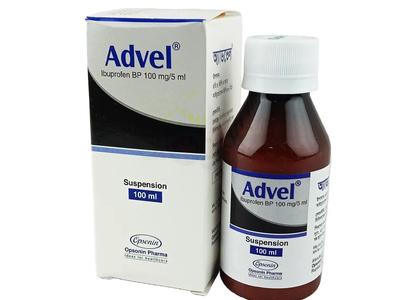
Advel 100 mg/5 ml
Ibuprofen
Category: Oral Suspension
Manufacturer: Opsonin Pharma Limited

Allopathic
MFG. Licence No. Biological
012
MFG. Licence No. Non-Biological
080
Address
Rupatali,
Price: 30.34 ৳
100ml bot
100 ml bottle

Medicine Selling service is not available yet.
Related Medicines

Uses of Advel:
- Pain relief
- Fever
Rheumatoid arthritis, Osteoarthritis, Pain, Fever, Pericarditis, Dysmenorrhea, Patent ductus arteriosus, Inflammation, Musculoskeletal and joint disorders
Active peptic ulcer; hypersensitivity. Neonates with congenital heart disease, suspected necrotising enterocolitis and active bleeding (parenteral).
Drugs for Osteoarthritis, Drugs used for Rheumatoid Arthritis, Non-steroidal Anti-inflammatory Drugs (NSAIDs)
Ibuprofen is a non-selective inhibitor of cyclooxygenase, an enzyme invovled in prostaglandin synthesis via the arachidonic acid pathway. Its pharmacological effects are believed to be due to inhibition cylooxygenase-2 (COX-2) which decreases the synthesis of prostaglandins involved in mediating inflammation, pain, fever and swelling. Antipyretic effects may be due to action on the hypothalamus, resulting in an increased peripheral blood flow, vasodilation, and subsequent heat dissipation. Inhibition of COX-1 is thought to cause some of the side effects of ibuprofen including GI ulceration. Ibuprofen is administered as a racemic mixture. The R-enantiomer undergoes extensive interconversion to the S-enantiomer in vivo. The S-enantiomer is believed to be the more pharmacologically active enantiomer.
How to use
Ibuprofen:
Take this medicine in the dose and duration as advised by your doctor. Swallow it as a whole. Do not chew, crush or break it.
Ibuprofen is to be taken with food.
Administration:
Should be taken with food.
Adult Dose:
Pain/Fever/Dysmenorrhea
200-400 mg PO q4-6hr; not to exceed 1.2 g unless directed by physician
Inflammatory Disease
400-800 mg PO q6-8hr; not to exceed 3.2 g/day
Osteoarthritis, Rheumatoid Arthritis
300 mg, 400 mg, 600 mg, or 800 mg PO q6-8hr; not to exceed 3.2 g/day
Severe hepatic impairment: Avoid use
Child Dose:
Fever
6 months to 12 years
5-10 mg/kg/dose PO q6-8hr; not to exceed 40 mg/kg/day
Pain
4-10 mg/kg/dose PO q6-8hr; not to exceed 40 mg/kg/day
Juvenile Idiopathic Arthritis
30-50 mg/kg/24hr PO divided q8hr; not to exceed 2.4 g/day
Renal Dose:
Significantly impaired renal function: Monitor closely; consider reduced dosage if warranted
Increased risk of GI bleeding w/ warfarin, corticosteroids, SSRIs and aspirin. May reduce the natriuretic effects of diuretics. Reduced antihypertensive effect of ACE inhibitors and angiotensin II receptor antagonists. May increase toxicity of lithium and methotrexate. Increased nephrotoxicity w/ ciclosporin and tacrolimus.
Active peptic ulcer; hypersensitivity. Neonates with congenital heart disease, suspected necrotising enterocolitis and active bleeding (parenteral).
Common
- Vomiting
- Stomach pain
- Nausea
- Indigestion
- Heartburn
1-10%
Dizziness (3-9%),Epigastric pain (3-9%),Heartburn (3-9%),Constipation (1-3%),Nausea (3-9%),Rash (3-9%),Tinnitus (3-9%),Edema (1-3%),Fluid retention (1-3%),Headache (1-3%),Vomiting (1-3%)
<1%
Acute renal failure (sometimes with acute tubular necrosis or hyperkalemia, polyuria, azotemia, cystitis, hematuria, decreased creatinine clearance, elevations in blood urea nitrogen (BUN) or creatinine without other manifestations of renal failure)
Agranulocytosis,Aplastic anemia,Erythema multiforme,Erythematous macular rashes,Exfoliative dermatitis,Hemolytic anemia (with or without positive direct antiglobulin test results),Neutropenia,Thrombocytopenia (with or without purpura),Toxic epidermal necrolysis (Lyell syndrome) and photosensitivity reactions
Potentially Fatal: Severe CV thrombotic events. Severe GI bleeding, ulceration and perforation.
Ibuprofen is not recommended during pregnancy or for use in nursing mothers.
Precaution:
Asthma; renal or hepatic disorders; bleeding disorders; CV disease. Pregnancy, lactation.
Lactation: Drug excreted into breast milk; use not recommended (American Academy of Pediatrics committee states that drug is compatible with nursing)
Gastric lavage, correction of blood electrolytes (if necessary). There is no specific antidote for Ibuprofen
Keep all medicines out of reach of children. Store in a cool and dry place, protected from light.
Drugs for Osteoarthritis, Drugs used for Rheumatoid Arthritis, Non-steroidal Anti-inflammatory Drugs (NSAIDs)
Ibuprofen inhibits synthesis of prostaglandins in body tissues by inhibiting cyclooxygenase-1 and 2. It has anti-inflammatory, analgesic and antipyretic properties.
Pregnancy category: C; D in 3rd trimester or near delivery. At >30 weeks' gestation; may cause premature closure of ductus arteriosus


Samm Care